
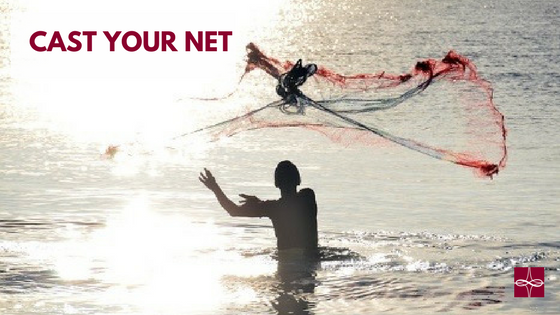
 Sometimes it’s easy to feel a little bit lost in Ordinary Time. We know that during Advent we are preparing our hearts and homes to celebrate the joys of Christmas. We light the candles of the Advent wreath, we sing Advent hymns, send Christmas cards, and prepare our Christmas gifts. During Lent, we fast, pray, and focus on giving what we have whether that be time, talent, or alms. We usually know that it is a time to repent and focus on daily mortifications that will draw us into a closer relationship with our Triune God and lead us to a beautiful celebration of the mysteries of our faith. So, what happens in the quiet stillness of Ordinary Time? I have recently come to be both terrified and in awe of this passage of time. Reflecting on the purpose and importance of this liturgical period, I am reminded of the story of Simon, James, and John in Luke 5: 1 - 11. The skill and trade of fishing is a perfect analogy for us. Fishing requires knowledge, skill, practice, patience, and, possibly above all, trusted intuition. Let us imagine this scenario as it unfolds. Simon, James, and John have been working throughout the night. They are no doubt exhausted and deflated when Jesus asks them to go out yet again. How often do we feel like this? How often do we feel God nudging us to try one more time, to keep going, to persevere? How do we respond to that? Do we quietly take our boat back out onto the water? Or do we rail against his request? In Luke 5: 4, Jesus does not simply ask that the boats be taken back out. He specifically asks Simon to “put out into deep water…” Where are the deep waters in our life? Where are the areas that Jesus is calling us that we cannot touch or perhaps not even see the bottom? The interchange that follows is striking. After Jesus asks Simon to lower his net, Simon replies that they have worked throughout the night and have caught nothing, “but at your command I will lower the nets.” Are we trusting Jesus enough in our lives to lower our nets of prayer, spiritual, or physical action when we have been toiling and have failed to see the fruits of our labor? After the resurrection, Jesus again meets His disciples in this way in John 21. After an uneventful day of fishing in the sea of Tiberias, Jesus instructs the disciples to cast their nets back into the water. They did not even recognize him at first but did as He instructed. The catch was so full that they struggled to pull it in. In both instances, Jesus requests His disciples to take action just one more time before giving up. Ordinary Time is our time of action and risk taking. This is our chance to act on our belief in God, the belief that we profess and strive to deepen during Advent and Lent. Are we praying and living as if we truly believe that the Triune God is all powerful and miraculous? Are we using the term, “Thy will be done” as a contrite spiritual, physical, mental, and emotional submission to His divine will and purpose or are we praying those words in the hopes that He will take action so that we can remain in our comfort zone? What open sea do we need to cast our net into? What prayer have we given up on because we’ve forgotten that God exists outside of time? This is when we put into action all that we’ve seen and heard. He is speaking our name, inviting us to trust Him, to “put out into deep water” and cast our net.
0 Comments
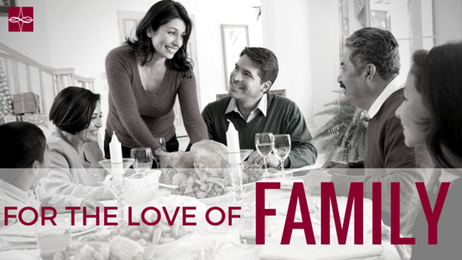 Today in the United States, families and friends gather together as they have for centuries around a shared meal to give thanks for their many blessings. A holiday rich with traditions, Thanksgiving brings about memories of eating at the “kid’s table,” cheering on family members in the annual Turkey Trot, late night dashes to the shopping mall and, of course, devouring enough food to last for days. For me, each of my cherished memories of this holiday share a common theme - the joy and love of time spent with my family. As we celebrate this holiday that brings our families together, I can’t help but recall the message of Pope Francis during his recent Apostolic Visit to the United States for the occasion of the World Meeting of Families. During the Festival of Families on Saturday evening, September 26th, Pope Francis sat and attentively listened as a handful of families came forward and shared the stories that had brought them to that stage on the Benjamin Franklin Parkway in Center City, Philadelphia. These families shared their own testimonies, speaking of the great joys in their lives, the suffering and losses they have experienced, the challenges, and the love that has held them together. I was incredibly moved to hear the stories of these families. Clearly, the Holy Father was as well, as he departed from his prepared remarks in his response. In speaking to the throngs of families present, he said, “The family has a divine identity card…God gave the family an identity card, so that families could be places in our world where his truth, love and beauty could continue to take root and grow.” This above all must be the primary mission of our families in today’s world. Inevitably, in our pursuit of this goal, each of us will encounter difficulties and setbacks that at times seem insurmountable. Pope Francis acknowledged this, saying, “In families, there are difficulties, but those difficulties are resolved by love. Hatred doesn’t resolve any difficulty. Divided hearts do not resolve difficulties. Only love is capable of resolving difficulty. Love is a celebration, love is joy, love is perseverance.” This Thanksgiving–in between the helpings of mashed potatoes, cheering on our favored football team and scouting out the biggest doorbuster deals–I hope this message from Pope Francis is one we keep close to mind. Our time spent with family, wherever we might be, is an opportunity to be a witness to God’s love. While we might have our disagreements and we might have our trials, with love we can persevere. And with love we can know an everlasting joy. On behalf of the entire Catholic Apostolate Center team, I wish you all a very blessed Thanksgiving!
 Forever and beyond will beauty last upon the fabric of this path we are all on. Life is a journey and a time of change, but the love and beauty that emits from the experience of life will last, will remain, and will persevere. Everything that goes through this life journey we lead as creations of a One, True, Loving Lord adds to the over-abundant beauty that is this light for our feet. From the spectacular of fireworks to the humblest of daily chores, everything holds within it an essence of glory, a glory given by the graces of the awakenings of the Spirit in this life. Such essence of glory protrudes into the days and nights, into our sensual stimulators by one path and one path alone, beauty. Beauty in the form of simple things, grand things, petty things, and profound things. Each passing moment has beauty in it to be recognized. All things bright and beautiful stem directly from our Divine Creator. All beautiful things reflect the love and care of the beautiful Father, abounding in glory and radiant light for all to experience.
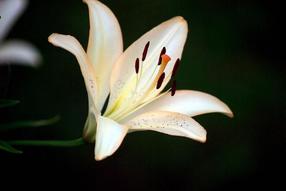
Beauty can be seen in everything and everyone, if only we have the courage and wisdom to look hard enough. Such avenues of beauty are the various art forms of life, for example, works of art, music, literature, friendships, emotion, or moments indescribable by words. Art forms are anything that leave an impression on us, for life itself is the grandest of art forms that pours forth in everything it is. It is hard for us all to see the beauty in suffering or in times of darkness, but that doesn't mean it isn’t there, in the wrinkles and the silver linings that radiate beauty in a different light than what we are used to. For life, beauty is there. The Saints are good examples of the beautiful life, each one leading vastly different lives. Life is beautiful in each human experience, including the suffering and dark stuff. The Saints are good demonstrations of the beautiful human experience, including within it all sides of life: the good, the bad, and the ugly. Saint Kateri Tekakwitha, whose feast we celebrate today, is quite extraordinary and is a good example of the kind of beauty I am discussing here. Her life, besides her ardent Catholic faith, was normal for a girl in her Native American village. Her life was beautiful in her great faith, in her dealings with her family and those who did and could not understand her reasoning for believing that Christ Jesus was her Savior, and finally in her simple yet profound suffering and eventual martyrdom. She is the “Lily of the Mohawks.” Contemplate the Lily for a moment: the petals, the pollen, the beauty. So simple yet so complex, yet beautiful in its complexity. This is Saint Kateri. She is the lily, the beauty of a life lead in the faith of Christ. Personally, I have had a special devotion to Saint Kateri ever since fourth grade. My teacher chose then Blessed Kateri to be the one we all prayed for in our daily prayer time. Growing off of that initial, prayerful experience with Kateri, when she was finally canonized, I studied her life and virtues in depth, reflecting and praying intentions through her intercession. For eyes to see the beauty of the world and of everything you experience, pray to Saint Kateri, and like a lily may she blossom in all of us the joy of the beautiful Savior, whose blood painted the most beautiful image of all, our salvation. William Clemens is an Undergraduate Student of Theology and Religious Studies at The Catholic University of America in Washington, D.C. 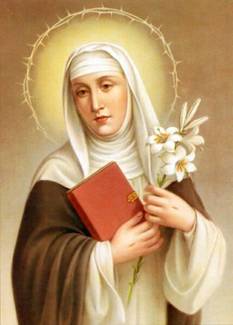 Courage and perseverance are two traits that I admire. The latter is a characteristic that not many people have, is hard to teach, and one that is imperative for success. In my classroom of 2nd graders, I try to remind them to “not give up, but try again and again.” When they become frustrated with challenging work or difficult friendships, they stop wanting to try again. They start to give up - but I tell them, “Keep trying!” and “Don’t be afraid to make a mistake!” Hopefully, one day my students will grow to recognize how courage can help them persevere through anything. People who do extraordinary things should be recognized for their courage and conviction. Saint Catherine of Siena, whose feast day we celebrated yesterday, is a woman whose contributions to the Church, taking action in times of need and exceptional theological writings, sometimes can be overlooked. Born in Siena, Italy in 1347, Catherine spent her life doing the will of God. She began receiving visions and praying to God from a very early age, even seeing in one in which Christ reassured her with an armor of courage that could overcome anything that tempted or threatened her. St. Catherine lived her entire life in prayer and was named a Doctor of the Church by Pope Paul VI on October 4, 1970. She along with St. Teresa of Avila and St. Therese of Lisieux are the three women to have been bestowed with such a title. St. Catherine worked to return Pope Gregory XI to Rome, from Avignon France where the Papacy had been residing for 67 years. Her determination to see this mission through was a testament to her unwavering courage to do God’s will. In her many philosophical letters, prayers, and the Dialogue, St. Catherine reflected on four theological concepts with which she considered while in ecclesiastical mysticism. The first was a Treatise of Divine Providence, the second was a Treatise of Discretion, third was a Treatise of Prayer, and finally a Treatise of Obedience. Throughout her courageous writings, she discusses the goodness of a person’s knowledge of God and his unending love for his children living on earth. Because of this prayerful life she led, in 1375, St. Catherine was blessed with the Stigmata on her hands, feet, and side. Her wounds reflected those of Christ’s and were only visible to the naked eye upon her death in 1380 at the young age of thirty-three. Found incorrupt in 1430, St. Catherine is now buried under the altar of Santa Maria Sopra Minerva, in Rome and a sculpture of her body is on display there, too. Throughout the year, let us strive to be like St. Catherine of Siena and take courage and persevere. Unshaken by those who challenged and doubted her, she remained steadfast in her commitment to Christ, His Church, and His people. You don’t have to be a saint to follow God’s call to courageous witness, but prayer and perseverance can lead you toward holiness in Christ. Krissy Kirby is a teacher for the Archdiocese of Washington, D.C.
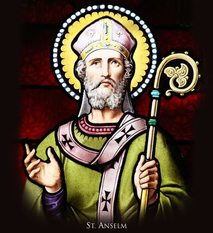 “Faith Seeking Understanding” is the motto of St. Anselm of Canterbury, whose feast we celebrate today, is a reminder to all Christians to seek God not only with our hearts but with our minds as well. St. Anselm, a Benedictine monk who lived during the 11th century, was known throughout Europe for his mind. He was a great scholar and strategist, having often put his wits against those of the English monarchy to try and preserve his own life and the life of the Church in England. However, his exercise of intellect during his life is not the “understanding” that his motto would prompt us to seek, nor that which lead him to be canonized a Saint. Rather it is the knowledge which Pope Francis spoke of in his general audience on May 21, 2014 “When we speak of knowledge, we immediately think of man’s capacity to learn more and more about the reality that surrounds him and to discover the laws that regulate nature and the universe. The knowledge that comes from the Holy Spirit, however, is not limited to human knowledge; it is a special gift, which leads us to grasp, through creation, the greatness and love of God…” This kind of knowledge, the knowledge of God, is far more precious than any other. How then do we obtain this most precious knowledge? St. Anselm would probably quote the words the founder of his order, St. Benedict, by saying “ora et labora” (pray and work). Indeed prayer and work, focused on God, will help lead someone to better understand God. Pope Francis, in that same audience on May 21st, gives us a possible focus for that prayer and work: creation. The Holy Father noted that although God gave the gift of His creation to man, that does not make mankind the “masters of creation.” The Holy Father continued by saying that “creation is not some possession that we can lord over for our own pleasure; nor, even less, is it the property of only some people, the few: creation is a gift…” All around us, especially as new life comes forth during this spring season, we can see God’s creation in its majesty. We must work then to care for it but also reflect and pray upon it. We must always seek to understand God so as to better conform our own lives to His will. Faith is a gift, and having faith is not the end of a journey but the start of a new one. St. Anselm teaches us that we must use our faith to seek understanding of the world around us and of the God who created us! Patrick Burke is a staff member at The Catholic University of America in Washington, D.C.
 “In the world there is often a lack of joy. We are not called to accomplish epic feats or to proclaim high-sounding words, but to give witness to the joy that arises from the certainty of knowing we are loved, from the confidence that we are saved”
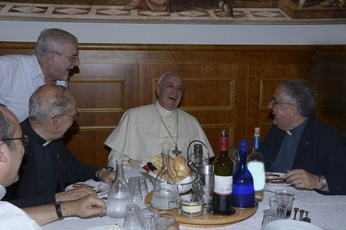
(Rejoice! (Letter in Preparation for the Year of Consecrated Life), n. 3) Last month, on the feast day of St. Ignatius of Loyola, Pope Francis went for lunch at the Generalate of the Jesuits. As I reviewed the pictures from his visit, joy and happiness are very evident. He appears very comfortable and relaxed with them, even though he may not know them well individually. Why is he comfortable? As a member of a religious community, I think that I can venture an answer. He is among those who shared a similar formation as he did as a member of the Society of Jesus. Technically, he formally ended his time as a Jesuit when he became a bishop. Bishops cannot be under the authority of the superior of a religious community. They can, though, ask to continue to use the religious initials of their community as well as wear the habit. Cardinal O’Malley, the Archbishop of Boston, continues to use the initials of the religious community that he came from, the Capuchin Franciscans, as well as wear the habit. Many religious communities even officially continue to count bishops among their membership. Some might think this strange, but the reality is that once a person is part of a religious community, it is part of who that person is and how the person approaches God, life, ministry. When you share a common formation and lifestyle from a relatively young age, that formation does not simply go away. It is a lifestyle that one freely chooses and it forms and informs the person. Once committed to, consecrated life (cf. Catechism of the Catholic Church, n. 913-933) is not something that can easily be cast aside. Even those who have left religious communities often continue to live the spirituality of that community as a single or married person or diocesan priest. I have seen it time and time again. Twenty-eight years ago today, I made my First Consecration of Promises as a member of the Society of the Catholic Apostolate (Pallottine Fathers and Brothers). Our six promises of poverty, chastity, obedience, sharing of resources, spirit of service, and perseverance have provided me with a way, within the context of our community life, to live the charity of Christ. I make no claim to live it perfectly, but I try to live it as authentically as possible. The way that I live more authentically is through the assistance of the members of my community who “urge me on” to live more fully in Christ’s love. This summer, more than most, I have had to even more deeply reflect on the quality of my life as a member of the Society. Am I living as an apostle, as St. Vincent Pallotti called all to do, reviving faith and rekindling charity? Have I fully surrendered, given, and offered myself to God, as the form of consecration of my religious community challenges me to do? If not, then why not? These questions have been very much on my mind as I form, with the help of God, a new member of the Society who began Postulancy only a few days ago. Thirty years ago last month, I did the same and have grown and developed spiritually and otherwise in ways that I would have never thought or imagined. As I work in formation with our Postulant, Brandon, I try to teach, but once again God causes me to learn and for that I am full of gratitude and joy. Pray for those in consecrated life, especially as the Church prepares for the Year of Consecrated Life that will begin this coming Advent! Fr. Frank Donio, S.A.C., is Director of the Catholic Apostolate Center and teaches for Saint Joseph’s College Online. This blog post was first published on August 17th on the St. Joseph’s College of Maine Theology Faculty Blog. Click here to learn more about our cooperative alliance with St. Joseph’s College Online 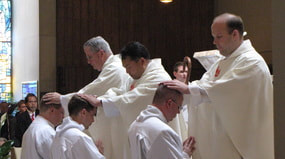 “So have you thought about becoming a priest?” As an altar server in my parish, many a priest (and well-meaning parishioner) would ask me this question as we were preparing for the celebration of Holy Mass. Even though this would stem from a casual conversation about my life, I was always somewhat taken aback by the harmless question put to me in that sacristy before I would automatically answer back to the smiling celebrant, “If God wills it!” To be honest, however, I felt lost. Some days I would think that being a priest was my calling, others that having a family was. In my life I would see hints of my calling everywhere— a Bible verse (i.e. Matthew 9:37) would tell me to be a priest while a smiling baby (and the occasional girl) would inspire me to be a dad. These mixed signals distressed me: despite my prayers, it seemed as if I would never get a firm answer to the life-changing question of what God wanted of me.
While I consider Saint Joseph my go-to-man for guidance on paternity, I look to Saint John Vianney, the patron of priests, for all matters concerning the Roman collar. The so-called “Curé of Ars” is an especially good model of strong will for both those preparing for the priesthood and anyone discerning God’s calling. From his youth he was filled with a great desire to “win souls for the good of God” by being a priest, though the turmoil of the French Revolution, having difficulty learning and memorizing in school, his father’s reluctance to not having him assist in the fields, being drafted into the military, suffering sickness, living amidst the government’s anti-Catholic persecution, and even being dismissed from the seminary in Lyon all stood in between the French man and his calling. At the age of 29, however, John Vianney was finally ordained, and he began to tend to the priestly and pastoral work in his parish. The same perseverance that enabled him to become a priest was now applied to the preparation of sermons, reflection on the works of spiritual writers and theologians, devotion to the Blessed Virgin Mary and Saint Philomena, self-mortification, and ministering through Eucharistic Adoration and the sacrament of Reconciliation. What an example of courage for those who today experience the grace of being called to the priesthood! With my own discernment process ongoing, I must remember that, despite the mixed signals I’m receiving as to what I am being called for, my vocation is not a problem to be solved! Rather, it is a personal call to holiness, one of joy and love. To worry excessively over this is to not allow God to work freely in my life nor trust that He will never lead me down the wrong path! Of course, the priesthood is not for everyone— fervent discernment will help determine if God is in fact calling a man to be consecrated in this way. Entering into a seminary is itself not a final decision but the best way to discover the authenticity of one’s vocation. Of course, the discernment process can also be started by simply conversing with a priest! In the Catholic Church, the role of the priest is vital. Tasked with the spiritual welfare of his flock, a priest is responsible for, but not limited to, celebrating daily Mass, administering the sacraments, offering counsel and comfort, leading retreats, catechizing, volunteering, and helping to run the parish community. He must be sensitive to the needs of his assignment while remaining obedient to the Church hierarchy. In addition, being a priest requires a 24/7 commitment with very little financial compensation;however, the reward for doing so— which is similarly offered to us all— is infinitely more fulfilling than a paycheck. In short, the priest is the mediator between God and His people. Just as Christ was sent by the Father, He in turn sent the Apostles into the world, so that “through them and their successors, the Bishops, He might continue to exercise His office of Teacher, Priest, and Shepherd… they are called to the service of the people of God” (Pope Francis’ homily given on Good Shepherd Sunday 2013, c.f. John 20:21-23). John Vianney similarly recognized the significant of the priesthood: “Oh, how great is a priest! The priest will not understand the greatness of his office till he is in Heaven. If he understood it on earth, he would die, not of fear, but of love.” Through the priest, we can glimpse the immense Love and grandeur of God: it is through him that Christ forgives our sins and through him that we receive the Body and Blood of our Lord. As I continue to discern my calling, I am reminded of all the priests God has placed in my life. These brave, holy, good, and faithful men of God have inspired me greatly with their joy, goodwill, patience, humility, and generosity in passing on the teachings of the Faith and caring for others. Like their patron, they trust in God to help them persevere through times of hardship and distress. They have readily answered God’s call of “Whom shall I send?” (Isaiah 6:8) and dedicated themselves to serving us through the example of Christ. They continuously pray for us; we must do the same for them! We are here today thanks to them. Thomas Wong is an undergraduate at The Catholic University of America in Washington, D.C. 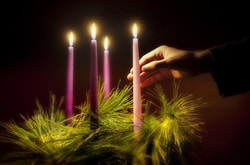 I have a very distinct memory from when I was a little girl (okay, twelve years old…) of anxiously awaiting the Christmas morning tradition of opening up Christmas presents. I was so excited that instead of waiting for the parental mandated 6:15am wake up call, I did it my way. I changed the time on my alarm clock, woke up my whole family and demanded that we start Christmas a little early. This moment of impatience several years ago plays into a much larger reality about this world that we live in – we are so anxious to get to the final destination as quickly as possible that we forget that the journey is just as important as the destination.
That is what Advent is – the journey to Christmas. The word itself comes from the Latin word adventus, which means “coming.” In the midst of the craziness of the holiday season–peppermint mochas and Hallmark Christmas movies included—it is natural to feel like these weeks leading up to Christmas are all about the countdown, and not about the coming. Just as I was all too anxious and turned the clock forward to get my Christmas day started, it is easy to wish away these days of simple waiting and trade them in for the hustle and bustle of Christmas Day. In an effort to more fully appreciate this journey to December 25th, it is necessary to find ways to live out this coming in our own lives. Practically, what does this mean? It means recognizing that the Advent journey requires silence, prayer and most importantly perseverance. Although everyone loves a good peppermint mocha, it is through these three things that we can ready the way for the coming of our Lord at Christmas. Although seemingly impossible, finding silence among the chaos of these days can be done in simple ways–whether it is turning off that Josh Groban Christmas song that has been playing on repeat in the car or taking the chance to catch one’s breath between glasses of eggnog at a family Christmas party. Finding times for prayer can be as unassuming as waking up five minutes early to read that day’s Mass readings or saying a Hail Mary when we are stressed. Lastly, perseverance is not only a necessity of the Christian life, but a necessary part of a peace-filled Advent. The most beautiful part of these days before Christmas is that the destination of our journey is not a rigged alarm, but God Himself in the unassuming form of a baby. This innocence of the baby Jesus reminds us that this season is a time for simple acts of faith, acts of faith that both allow us to appreciate the gift that is waiting for us and the journey that makes it possible. Lauren Scharmer is a senior at The Catholic University of America and is active in retreat and youth ministry in both the Archdiocese of Washington and the Diocese of Arlington. |
Archives
April 2024
Categories
All
|


 RSS Feed
About |
Media |
© COPYRIGHT 2024 | ALL RIGHTS RESERVED