
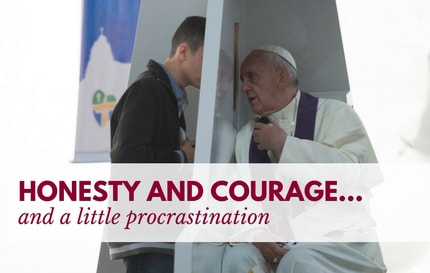
 "The confession of evil works is the first beginning of good works." -St. Augustine I’ll come right out and say it: I dislike going to Confession. I really do. And so I avoid it like the plague. We all have our struggles in faith, and this is my biggest one. “Why do I have to seek out a priest, another human, and tell him all the bad things I’ve done? Can’t I just talk to God directly? Doesn’t God hear everything in your heart?” We’ve all heard these questions—challenges, really—about the need for regular visits to the confessional. After all, God does know everything in our hearts. We can talk to him directly, and we should do so often! But we need more than just that internal dialogue with God. Our faith, after all, isn’t one lived alone. St. Paul tells the Romans, “We, though many, are one body in Christ and individually parts of one another.” (Romans 12:5) I may be a toe, you may be an earlobe, but we all, collectively, make up the one Body of Christ in the Church. So if that’s what we truly believe, and one of those parts gets hurt, the whole rest of the body feels that pain. If you stub your toe, the whole of your body stops everything and focuses on that pain. So, too, when we stub our spiritual toe, we create a ripple throughout the rest of the Body. We could talk at length about the nature and effects of sin, but that’s for another discussion. The point is that each of our sins have an effect, not just on ourselves and on God, but on the whole of the Church, too. And so we have three people or groups to reconcile with when we’ve sinned: ourselves, our Creator, and the larger Body of which we are each a part. And who better to forgive our sins than a priest? He’s a spiritual father, a representative of the Church, and, most importantly, someone who acts “in persona Christi,” or “in the person of Christ.” By virtue of his ordination, each priest has been given some pretty awesome powers. He can baptize people, he can bless places and things, he can call down the power of God onto simple bread and wine, miraculously turning it into Christ’s Body and Blood. So if he can do all those things, can’t he also exercise the power Christ gave the Apostles after his Resurrection? “Whose sins you forgive are forgiven them, and whose sins you retain are retained.” (John 20:23) That’s crazy! But it’s our faith, and it comes from Christ himself. We profess this in the Apostle’s Creed: “I believe…in the forgiveness of sins…” Now we’re all thinking, “Okay, that’s all well and good, but Confession is still too uncomfortable.” And you’re right! It is. That’s why I dislike going. I don’t like being uncomfortable. I don’t like to acknowledge the messy parts of life, including my own failings and shortcomings. I don’t like to admit that I’m wrong, especially when I keep doing the same wrong thing over and over again. But every time I finally buck up the courage (sometimes after months or years) to walk into a confessional, I’m never disappointed. The result is always the same: God has forgiven me and wiped the slate clean. And I feel so good about it! It’s not that I’m afraid of God’s mercy. In fact, I crave it. The problem is that I’m too afraid of my own self, of my own fragile and broken humanity, to even ask for this mercy. In my heart of hearts, I don’t believe I deserve it. And that’s the thing: none of us deserve it. Not one of us can ever be sorry enough, contrite enough, penitent enough, to make amends for what we’ve done and continue to do over and over again. We can never fully make it up to God; that’s why he sent his Son. Jesus took the sins of the whole world on his shoulders, beaten and bloodied though He was, until he became sin itself: “For our sake he made him to be sin who did not know sin, so that we might become the righteousness of God in him.” (2 Corinthians 5:21). He took every sin each of us will ever commit, carried them up on the cross, and died as payment for it. He’s already paid the price for us. It’s like a spiritual gift card that never expires, but we have to use it to take advantage of the gift. That’s why Confession is so important: the mercy is guaranteed; we have but to ask for it. Pope St. John Paul II once said, “Confession is an act of honesty and courage - an act of entrusting ourselves, beyond sin, to the mercy of a loving and forgiving God.” In this Jubilee Year of Mercy, may we all be honest and courageous enough to do that. Whether you just went to Confession last week or, like me, have been putting it off for way too long, be courageous and just go. Let the Year of Mercy have some personal meaning for you, and let God forgive you for what He’s already paid for upfront. For more resources on Confession and the Jubilee Year of Mercy, please click here.
0 Comments
 I remember the first time I felt true repentance. It was not because I got caught making a bad decision; not because I simply felt guilty; not because I thought about what others might think of me—all of which might be gateways to repentance, but not sufficient in and of themselves. I remember the first time I felt true repentance out of love of Christ and sorrow for the rejection of His love through my sin.
I was in a small chapel in the hills of Los Gatos on a five-day Ignatian Silent Retreat. The assignment on this particular afternoon was to spend time praying over and reflecting on your past sin, on how you had rejected God’s love and, in so doing, on how you had contributed to His pain on the Cross. It was a heavy day. I took a deep breath in the chapel and started remembering and reflecting on past sinful decisions. Some, I knew blatantly. Others seemed inspired by the Holy Spirit. I had not even realized how past decisions might have affected other people more than myself, and I was illuminated in such a way that I saw how my sins spread out like a web contaminating the lives of others. Tears flowed unguarded from my eyes. How could I have done such things? I placed myself within the crucifixion narrative and saw that I had joined the Roman soldiers with their whips, their taunts, their hammers. I had pierced my Lord. I felt terrible—like the scum on the bottom of a lake in the darkness. And then I felt Him. I felt His gaze from the tabernacle. He beckoned me, inviting my eyes to meet His own. “I can’t look back at you, Lord,” my heart said. “I’m too broken, too ashamed, too unworthy.” I kept looking down at my lap, afraid to meet His gaze. But the feeling of being looked at persisted, gently. After a few moments, I could no longer bear it. Anything, even Christ’s condemnation, would be better than avoiding Him. I looked up. And I met Love. I felt Christ’s presence in the tabernacle and saw Him looking at me as a bridegroom looks at his bride on their wedding day: joy, peace and love filling his face, eyes brimming with pride and tears and awe. The gaze with which Christ looked at me turned my blemishes into radiance. I became a spotless bride because of the overflow of His love. I knew, in the midst of my sin and ugliness, perhaps the ugliest I had ever felt, that I was inherently and infinitely loved, that my dignity was in Him. And so the tears flowed evermore—tears of humility, peace and joy. I had been given yet another chance, which I used to further receive the Sacrament of Reconciliation. I assume the joy and freedom I felt after this experience and after going to Confession is how Mary Magdalene felt when she met the Christ and was freed from seven demons. We know with certainty that Mary Magdalene had been cured of seven demons, that she was a follower of Christ and that she was present at the crucifixion. We also know Mary Magdalene, like all of us, was a sinner. When Christ met her, she might have given up. She had been plagued by seven demons and thought that perhaps she would never be free. Christ offers her another alternative: freedom. As a result of our encounter with Christ's forgiveness--both by encountering His love and by being reconciled to Him--we can live in the joy of the Resurrection. For this reason, it is fitting that Mary Magdalene is cited as the first witness of the Resurrection. St. Augustine called her the Apostle to the Apostles. We find Mary Magdalene in John's Gospel weeping by the open tomb of Jesus three days after His burial, for she thinks His body has been stolen. When Christ meets her, she mistakes him for the gardener. “Mary!” Jesus exclaims to his forlorn disciple, calling her by name (John 20:16). “Kate!” He exclaimed to me in the chapel. He meets us in our despair, our sorrow. Only then can we join Mary Magdalene in looking at Christ, recognizing Him and meeting His gaze. I imagine she grasped her bridegroom’s feet, kissing them in thanksgiving and bowing before Him. We cannot stay there in gratitude. Christ called me to go out from the chapel and to go out after receiving the Sacrament of Reconciliation, as he did Mary Magdalene: “Do not hold on to me, because I have not yet ascended to the Father. But go to my brothers” (John 20:17). The repentant sinner becomes the Apostle to the Apostles. This can only be so after we have encountered the love of God. Today, I invite you to an examination of your own sin, of any time you have rejected God’s love. Do so in a sacred place: a chapel, a Church, a reverent place in your house. I invite you to this in order to surrender these moments over to Christ and to allow Him to transform them by His love. Allow Him today to gaze at His beautiful creation, which has become broken or tarnished by the Fall and by sin, and allow Him to meet you where you are at, to love you there. Only by knowing how infinitely you are loved will you be able to “go to [His] brothers,” to go out to all the world in love—radiant, joyful and renewed. Kate Flannery is the Social Media Coordinator for the Catholic Apostolate Center 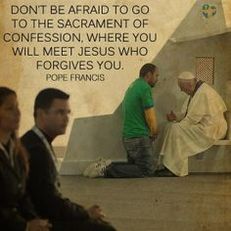 A few weeks ago, there was a story making its way around the internet about a priest who was taking Confessions via Snapchat, a popular app that allows users to send pictures and video with captions which disappear after a few seconds. There has been no concrete confirmation that this priest is a Catholic priest in good standing with the Church, but nevertheless it made me think about the concept of receiving Confession in non-traditional ways. At first glance, the idea of Confession via Snapchat seems like an interesting idea - for priests to meet young people where they are and making an often overlooked Sacrament readily available. But this type of Confession diminishes the Sacramental importance of receiving absolution, and also has canonical implications as well.
For a priest to offer Confession via Snapchat makes the Sacrament invalid, as the Code of Canon Law clearly states that “the proper place to hear Sacramental Confessions is a church or oratory” and that “Confessions are not to be heard outside a Confessional without a just cause” (CIC 964 §1, §3). For a valid Sacrament to take place, the priest and penitent must be physically present in the same place. With the advent of technology, the Code ensures that the Sacraments are still celebrated properly, and that we aren’t receiving absolution by email, telephone, text, or Snapchat! Going to Catholic schools my entire life, the seasons of Lent and Advent were popular times for schools to offer Confession. Typically, we would be shepherded to the Church or Chapel during theology class and given the opportunity to go to Confession if we wanted to. However, one time I received a knock on my door and was told that if I went to Confession, I would receive a cupcake. It seems silly now to basically be bribed by a cupcake, but not one to turn down free cupcakes, I happily obliged. Technically, this also is not a licit celebration of the Sacrament. To go to Confession, the Code also tells us that a person must be “properly disposed” which means not coerced by another person (CIC 962 §1). Although these canonical distinctions might seem like trivial technicalities, they ensure that we enter the Sacrament with an open heart, ready to receive the gift of God’s love and forgiveness with no reservations. For a good part of my life, I was uncomfortable going to Confession, but as I’ve gotten older I’ve learned to become less afraid of this Sacrament. One of the best experiences I had with Confession was in college when priests would come to our residence halls to offer the Sacrament. The residence hall lounge had been turned into a casual Confessional and I had a wonderful discussion with the priest who was there. I realized that going to Confession doesn’t have to be a big scary endeavor and the feeling of grace when I received absolution was incredible. This past Sunday we celebrated Palm Sunday, the beginning of Holy Week. At the end of this week we will celebrate the Easter Triduum. Going to receive the Sacrament of Confession is a wonderful way to prepare yourself spiritually for Holy Week. From Palm Sunday, throughout the Triduum, and on Easter Sunday, we journey with Christ as he sacrifices himself for our sins and rises again. Confession prepares our hearts for the joy of Easter morning, allowing us to begin the season of Easter with a “clean slate.” Haven’t been to Confession in a while? Check out our Lenten Resource Page which includes some great resources on the Sacrament of Penance. Rebecca Ruesch is the Blog Editor for the Catholic Apostolate Center  This Lent, my 2nd grade class is in charge of encouraging our school to donate to CRS Rice Bowl, a program which helps raise money for those who are less fortunate in 6 places around the world. Our school’s efforts help students raise awareness of hunger and poverty. My class has been determined to give all they can in the past for service projects, but what sets this project apart? That is the question I have asked my students to ponder. One girl told me that her snack after school is Doritos, so for each day she doesn’t snack on this favorite treat, a quarter will be added to her jar for someone “hungrier than me.” Another boy told he scours his house and cars for loose change, and drops it in the Rice Bowl whenever he finds anything, even a penny. He asked me, “Every bit counts, right Ms. Kirby?” Indeed it does.
As Pope Francis reminded us at the beginning of the Lenten Season, our fast must be a fast from indifference toward others. The time has come for us to use these remaining 40 days to contemplate our actions toward others, striving for the utmost respect and care for them. Instead of searching for ways to improve our own lives, maybe it is time that we turned to the poor and vulnerable and improve theirs. Francis writes, “Indifference to our neighbor and to God also represents a real temptation for us Christians. Each year during Lent we need to hear once more the voice of the prophets who cry out and trouble our conscience.” It is not sacrifice to give of our excess or to simply change our diets during Lent, our Holy Father is calling us to fast from our indifference and turn to love. In this New Evangelization, there are tangible and realistic ways for each and every one of us to change hearts. This change must start within our own broken and sinful hearts and through God’s mercy and forgiveness. For each thing we do for our hearts, let’s do something for someone else. Here are some ways you could “fast for indifference”: 1. Do an Examination of Conscience and ask God to forgive your sins through the Sacrament of Reconciliation 2. Go and forgive those who have wronged you 3. Pray for those in your life 4. Intercede for others each day 5. Fast and acknowledge the poor 6. Volunteer in some way, perhaps by serving in a soup kitchen or shelter 7. Add prayer time to your day 8. Write in a journal 9. Attend Mass more frequently As you go about your day during this Lenten season, stop and think about what Jesus has done for your life and what you have done for others. Contemplate all that you have done and remember your responsibility to love others as Christ loved us all. If what we can give only fills a CRS Rice Bowl, or we give up indifference and care deeply for the poor, just know that “every bit counts.” Krissy Kirby is a teacher for the Archdiocese of Washington, D.C. To learn more on the CRS Rice Bowl please check out our Lenten Resources!  Having just celebrated the Second Sunday of Advent, we heard in the First Reading from Isaiah how, “Every valley shall be filled in, every mountain and hill shall be made low; the rugged land shall be made a plain, the rough country, a broad valley. Then the glory of the LORD shall be revealed...” What always strikes me about this reading is how the Lord destroys every obstacle in His way, and all that stands against Him is defeated. This alone is important to remember I think, because in the midst of so much activity and stress it is easy to forget that our Lord is always the one in charge and has the power to wash away all of our blemishes and sins. Everything with imperfections is made perfect in Him.
Advent is a time of preparing ourselves for the birth of our Savior and the second coming of Christ. The Church gives us this liturgical time so that we may ensure we are ready for Christ’s entrance into our midst on the Solemnity of the Nativity of our Lord and prepare for how “He will come again in glory to judge the living and the dead.” So, Advent is a time of great hope, expectation, and preparation, but how exactly can we prepare our hearts for Christ? How can the Lord wipe away my own sin, my own imperfections so that I can worthily prepare for His Coming? Partaking in the Sacrament of Reconciliation is a perfect way to prepare our hearts for Christ’s coming and be ready for His arrival. We hear in the Second Reading of this past Sunday how the Lord, “is patient with you, not wishing that any should perish but that all should come to repentance.” The Lord never tires of extending forgiveness to us, He is ever merciful. He wants the best for all of us, even when sometimes we don’t know exactly what that is. Just as in Isaiah, the Lord defeats and washes away all of our sins and imperfections with this wonderful Sacrament. Pope Francis during one of his Wednesday audiences said, “every time we go to confession, God embraces us.” With all of the different parties and events during this time of year, with all the invitations, there is one invitation that you should be certain to consider. The Lord has already extended to us the invitation, an invitation that prepares us for Christ’s coming by partaking in the Sacrament of Reconciliation. The question is - will you accept it? Conor Boland is a College Ministerial Intern at One Bread, One Cup and is an undergraduate at The Catholic University of America. For more information on Reconciliation and the Advent season, please see our Advent Resources!  As I finally sit down to write this post, I once again have that awful realization that I’ve let my tendency to procrastinate get the best of me. And, once again, I beat myself up over it because I know I’ve failed to follow through and honor my word: “You have a college degree! You should know how to properly manage your time! You’re better than this! Stop being such a failure!” and on, and on. It’s a cycle of self-deprecation that so many of us fall into, particularly young adults.
When I did some investigation on St. Jerome, whose feast is today, I laughed at myself over that train of thought. Most well-known as the biblical scholar who revised the Latin Bible (generally known as the Vulgate), this Doctor of the Church was also incredibly hard on himself when he failed. Butler’s Lives of the Saints says of Jerome: He was, as someone has said, no admirer of moderation whether in virtue or against evil. He was swift to anger, but also swift to feel remorse, even more severe on his own shortcomings than on those of others. A pope is said to have remarked, on seeing a picture of Jerome striking his breast with a stone, "You do well to carry that stone, for without it the Church would never have canonized you." I suppose we young adults are in good company when we, too, are hard on ourselves for missing the mark. It’s really no wonder Catholic young adults have such difficulty accepting those times we fall flat on our faces. Fresh out of our academic careers, whether high school or college, we’re used to very high expectations on our performance. We tend to gauge our self-worth on quantifiable “goals”: our GPAs, extracurricular involvement, “likes” on Facebook, retweets on Twitter, number of job interviews, etc. Every time we miss the mark we’ve set for ourselves, it somehow translates to utter personal failure. This, of course, is foolishness. It’s all well and good to be involved and occupy our time with things. St. Jerome himself said, “Be ever engaged, so that whenever the devil calls he may find you occupied.” It’s another thing, though, to obsess over being occupied and, thus, increasing our chances at “being successful”. We know it in our heads, but fail to grasp it in our hearts, often at great detriment to our interior lives. All of these “real world” struggles have a profound effect on our spiritual well-being. As soon as we begin to think poorly of ourselves for underperforming in worldly things, we become overly critical of our spiritual shortcomings. We keep failing at (insert your habitual sin(s) of choice) and beat ourselves up every time. This can be even worse for the soul than the particular sin itself; we begin to believe that we’re not worthy of being fixed. So what is one to do? I’m no spiritual guru, but I can share a few things that continue to help me overcome this recurring sense of unworthiness. 1. Daily Prayer- It goes without saying that daily prayer is essential. Even if you start with “Hey God, it’s me again. I’m sorry I keep failing at this. Please help”, you’ll reap the benefits immediately. Like with any other relationship, frequent dialogue is of primary importance. 2. Mass- The Eucharist is literally the greatest physical thing in the world: Christ in the flesh. We have the opportunity to receive Him every single day; take advantage of it. And while you’re at it, take a leap of faith and try out… 3. Reconciliation- Yes, the oft-dreaded Confessional. Admittedly, I absolutely hate going—but I sure love leaving! While it’s hard to do, it’s like anything else in life: the greatest reward comes from the greatest sacrifice. Take a leap of faith if you’ve been away for a while. The “spiritual car wash” really is one of the greatest gifts God offers us. 4. Spiritual Direction- Regular dialogue with a spiritual guide provides an objective view of our journey. It takes a level of openness and vulnerability, but having someone to walk with gives us much-needed encouragement and accountability. 5. Patience- St. Francis de Sales said it best: “Have patience with all things; but, first of all, with yourself.” We’re humans, and fairly young ones at that. The expectation we place on ourselves to be perfect is so unreachable because we’re inherently imperfect. We’re constantly developing, growing, falling down and getting back up again. It’s only God who can make us perfect; we just keep getting in His way. The next time you go all St. Jerome on yourself, drop that stone and look instead to the One who is Perfection itself. He’ll help you back up on your feet every time. Ad Infinitam Dei Gloriam Jay Schaefer is the Webinar Associate for the Catholic Apostolate Center and a civil engineer in the Baltimore Area. 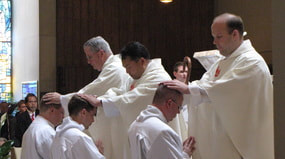 “So have you thought about becoming a priest?” As an altar server in my parish, many a priest (and well-meaning parishioner) would ask me this question as we were preparing for the celebration of Holy Mass. Even though this would stem from a casual conversation about my life, I was always somewhat taken aback by the harmless question put to me in that sacristy before I would automatically answer back to the smiling celebrant, “If God wills it!” To be honest, however, I felt lost. Some days I would think that being a priest was my calling, others that having a family was. In my life I would see hints of my calling everywhere— a Bible verse (i.e. Matthew 9:37) would tell me to be a priest while a smiling baby (and the occasional girl) would inspire me to be a dad. These mixed signals distressed me: despite my prayers, it seemed as if I would never get a firm answer to the life-changing question of what God wanted of me.
While I consider Saint Joseph my go-to-man for guidance on paternity, I look to Saint John Vianney, the patron of priests, for all matters concerning the Roman collar. The so-called “Curé of Ars” is an especially good model of strong will for both those preparing for the priesthood and anyone discerning God’s calling. From his youth he was filled with a great desire to “win souls for the good of God” by being a priest, though the turmoil of the French Revolution, having difficulty learning and memorizing in school, his father’s reluctance to not having him assist in the fields, being drafted into the military, suffering sickness, living amidst the government’s anti-Catholic persecution, and even being dismissed from the seminary in Lyon all stood in between the French man and his calling. At the age of 29, however, John Vianney was finally ordained, and he began to tend to the priestly and pastoral work in his parish. The same perseverance that enabled him to become a priest was now applied to the preparation of sermons, reflection on the works of spiritual writers and theologians, devotion to the Blessed Virgin Mary and Saint Philomena, self-mortification, and ministering through Eucharistic Adoration and the sacrament of Reconciliation. What an example of courage for those who today experience the grace of being called to the priesthood! With my own discernment process ongoing, I must remember that, despite the mixed signals I’m receiving as to what I am being called for, my vocation is not a problem to be solved! Rather, it is a personal call to holiness, one of joy and love. To worry excessively over this is to not allow God to work freely in my life nor trust that He will never lead me down the wrong path! Of course, the priesthood is not for everyone— fervent discernment will help determine if God is in fact calling a man to be consecrated in this way. Entering into a seminary is itself not a final decision but the best way to discover the authenticity of one’s vocation. Of course, the discernment process can also be started by simply conversing with a priest! In the Catholic Church, the role of the priest is vital. Tasked with the spiritual welfare of his flock, a priest is responsible for, but not limited to, celebrating daily Mass, administering the sacraments, offering counsel and comfort, leading retreats, catechizing, volunteering, and helping to run the parish community. He must be sensitive to the needs of his assignment while remaining obedient to the Church hierarchy. In addition, being a priest requires a 24/7 commitment with very little financial compensation;however, the reward for doing so— which is similarly offered to us all— is infinitely more fulfilling than a paycheck. In short, the priest is the mediator between God and His people. Just as Christ was sent by the Father, He in turn sent the Apostles into the world, so that “through them and their successors, the Bishops, He might continue to exercise His office of Teacher, Priest, and Shepherd… they are called to the service of the people of God” (Pope Francis’ homily given on Good Shepherd Sunday 2013, c.f. John 20:21-23). John Vianney similarly recognized the significant of the priesthood: “Oh, how great is a priest! The priest will not understand the greatness of his office till he is in Heaven. If he understood it on earth, he would die, not of fear, but of love.” Through the priest, we can glimpse the immense Love and grandeur of God: it is through him that Christ forgives our sins and through him that we receive the Body and Blood of our Lord. As I continue to discern my calling, I am reminded of all the priests God has placed in my life. These brave, holy, good, and faithful men of God have inspired me greatly with their joy, goodwill, patience, humility, and generosity in passing on the teachings of the Faith and caring for others. Like their patron, they trust in God to help them persevere through times of hardship and distress. They have readily answered God’s call of “Whom shall I send?” (Isaiah 6:8) and dedicated themselves to serving us through the example of Christ. They continuously pray for us; we must do the same for them! We are here today thanks to them. Thomas Wong is an undergraduate at The Catholic University of America in Washington, D.C. |
Archives
July 2024
Categories
All
|

 RSS Feed
About |
Media |
© COPYRIGHT 2024 | ALL RIGHTS RESERVED