
|
8/24/2021 It Will All Fall Into Place: Reflections on Graduating During the COVID-19 PandemicRead Now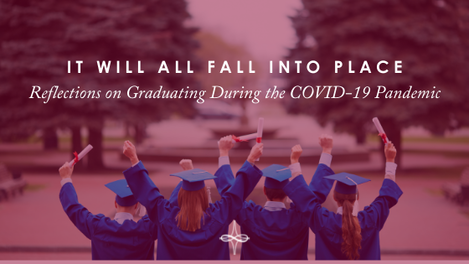 2020 was a difficult year for so many people; it is safe to say that we all were impacted in some way. To me it felt like the entire world stopped and everything started moving in slow motion. March 2020 was my senior year of college—what was supposed to be the best semester of my life, the beginning to the end, the start of a new chapter. Yet, there I was, driving back to my family home in Massachusetts to study and then graduate in the home that I grew up in. I felt so crushed, defeated, and overwhelmed. I remember that Easter, only a few weeks into the pandemic, feeling so overjoyed that some of my friends and parish community decided to come together and celebrate our Risen Lord. We had a drive-by celebration in the parking lot where our pastor blessed each of us and we waved at our friends from the safety of our car. I felt so overjoyed to see their faces and to get a glimpse of normalcy. I remember that Easter morning being filled with joy, possibly the Lord’s way of showing us that there is a light at the end of the tunnel. Yet, around that same time, we found out that school was cancelled for the rest of the semester and Zoom became our new normal. I remember thinking, “The last time I stepped into a classroom was the day before spring break and all I wanted to do was get out of there, but now, I’ll never be able to go back.” While that may have been a bit dramatic, it truly was a time where my faith was the only thing that was able to guide me. While I was upset over the loss of my senior year and the loss of long-anticipated memories, I was so thankful and blessed to have my health, my family, and my faith. There were so many people grieving the loss of family members, enduring financial difficulties, and risking their lives on the frontlines of the pandemic. It was hard not to laugh at myself for crying over my difficulties when faced with the reality of what was going on throughout the world. The Lord guides us on a path. Though we may not know where or how it ends, we know He is there. I knew this time in my life would already be difficult—saying goodbye to friends, trying to find a “real” job, and trying to balance new responsibilities. Adding to that the uncertainty of a pandemic only exacerbated the overwhelming anxiety I knew was around the corner. I kept repeating this phrase over and over in my head: “it is all part of God’s plan.” The phrase kept rekindling faith in my heart when things began to feel difficult. It can be seen as a silly, trite phrase. But for me, the impact it had on my life was so important. It helped me to have a conversation with the Lord daily—whenever things felt tough or I felt defeated or just lost. After repeating the simple phrase over and over in my head, I felt the Lord’s presence like a hand on my shoulder continuing to guide me throughout life. I couldn’t help but exhale. Graduation came and went. I wore my cap and gown in my childhood living room surrounded by my parents trying to figure out how to set up Zoom on the T.V. It was an underwhelming experience compared to the grand festivities I had imagined, yet I was very thankful to be able to celebrate with my parents. Trying to navigate through “adult life” during the pandemic proved to be difficult within itself. It felt so easy to isolate myself from those around me and to disconnect from everything. Everything seemed big: applying for jobs, getting my first apartment, living in the city. It often felt easier to give up when things got difficult. But that is exactly the opposite of what the Lord calls us to do. The Lord wants us to call upon him during the difficult times and to remember that everything is part of his plan. He is there to walk with us through the ups and downs and invites us to lean upon his strength in times when ours fails. While the road ahead seems uncertain, there is one thing that we can count on - the love and support of the Lord. Over the past year, what I have found is that everything is part of His plan; every small step we take, every thought that enters our mind, every mundane task—it all will fall into place.
1 Comment
 Walking into the endzone of FedEx Field of the Washington Football Team made everything feel real—not some fantasy about playing professional football, but the reality of graduating college and entering into a new stage in life. In the middle of May, I graduated from The Catholic University of America at FedEx Field. It was an experience filled with much joy, but also some uncertainty. The joy and happiness were palpable throughout the stadium. It was rewarding seeing four long, hard years of work and late nights come to fruition. I felt a happy sense of relief that we had made it through the chaos and craziness of the past three semesters amidst the pandemic. It was exciting getting to celebrate with our friends and family—a truly special ceremony. Later that day, I began to feel some uncertainty mixed in with my joy. Friends were moving back home or across the country. Some friends were starting new jobs while others were going to graduate school. Some friends were younger and would still be at school another year while other friends had full-time jobs. There was a lot still up in the air. Over the past couple of weeks since graduation, I have reflected on that uncertainty and realized that it relates to a lot going on today. There’s uncertainty in starting a new job, in moving, or any type of new beginning. There’s uncertainty in returning to work in person maybe for the first time in a long time. There’s even uncertainty about traveling and going on vacations with differing restrictions. As I reflected on the uncertainty I felt from graduating college, I was comforted by one simple fact: the same Jesus who was present and working in my life before will be present throughout the uncertainty. During the Nicene Creed, we say, “I believe in one, holy, catholic and apostolic Church.” In these four marks of the Church, catholic is referring to the universality of the Church. This is what I found comfort in. Even though I wouldn’t be going to Mass at Catholic University anymore, Jesus would be present at Mass at my new parish community. Even though I wouldn’t have the ability to go to a chapel as frequently, Jesus would still hear my prayers throughout my workday. I found this realization comforting and encouraging – I knew Jesus would be present throughout the uncertainty and the change. I began to think of ways that I could actively embrace the uncertainty by welcoming Jesus into the small day-to-day actions that I knew would come about because of the changes. I set two goals for this uncertain time:
 Transitions can sometimes be the hardest part of our lives. Often, transitions are filled with hope and anticipation, but other times they are filled with fear and anxiety. The transitions I’m currently thinking of include moving, new jobs, graduation, marriage, children, losing a loved one, and many more. Everybody's lives change, both in good times and in more difficult ones; the key is figuring out how to maneuver through those changes and create new beginnings.
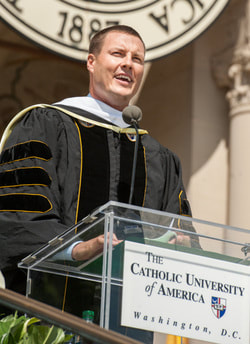
Transitions often change our faith-based routines. Prayer, Mass times, and proximity to a Church are the top contenders for what may be lost or overlooked in these fearful times of anticipation and uncertainty. What we forget is that prayer and dependence on Christ are the most important things to hold onto. As Psalm 77: 1-2 says, “I cry aloud to God, aloud to God, and he will hear me. In the day of my trouble I seek the Lord…” When we are afraid or in trouble, God is there. He is there in the easy and joyful transitions, too, waiting for gratitude and recognition. Our faith is the vehicle by which our lives are maneuvered. All of life’s stop signs and road blocks, in each pit stop and flat tire, in every new paint job and deep clean, Christ is there as our GPS if we let him. No matter how long it takes to recalculate our journey through transitions, God is with us and wants us to ask for guidance. I have recently graduated from college, a time that brings many changes. In our commencement address, we received one solid takeaway: nunc coepi, which is Latin for, “Now I begin.” I’m realizing, as did our incredible Catholic speaker, that in all of life’s transitions, nunc coepi is applicable. If during life’s stop signs, we say, “nunc coepi,” we can continue with our job searches. If at a financial roadblock, we say: nunc coepi, recognizing that God will provide and make sure the bills are paid. It can be a simple phrase that helps us recognize the blessings, and continue on with whatever God’s plan for happens to be. The faith behind the phrase nunc coepi shows faith in God’s plan for each of us, and through each of life’s transitions. My favorite verse in the Bible comes from the moment that Gabriel tells Mary that she has been chosen to be the Mother of Jesus, and says in Luke 1: 37-38, “Fear not! For nothing will be impossible with God.” And then Mary responds with, “Behold, I am the handmaid of the Lord, let it be done to me according to Thy Word.” Like Mary’s response to her own life-changing moment, can we say “Yes” to God? Can we, in our own transitions, continue to say, nunc coepi? Now I begin. Krissy Kirby is a graduate of The Catholic University of America with a degree in Early Childhood Education.  The night before I travel - whether by car, air or sea - I can’t help but begin to feel anxious and get a little overwhelmed about my upcoming journey. No matter how prepared I think I am or how necessary the trip is, I loathe the process of travelling. I’ve never had a ‘bad’ experience, but it isn’t something on my list of things to do every day either. While I’m sure I’m not alone in my sentiment, and there are probably 101 diagnoses as to why I don’t like travelling, I think it boils down to the fact that transition, no matter the circumstances, causes an upheaval of routine.
Throughout our lives, each of us has experienced the anxieties of transition in one way or another: graduating from school and starting a new job; getting married and having children; getting sick or losing a loved one. Every stage of our lives carries with it transition and to some extent, a change in routine. The Book of Ecclesiastes acknowledges this idea in a very poetic way: “There is an appointed time for everything, and a time for every affair under the heavens” (Eccl 3:1). The start of Ordinary Time is no different. While most of us would consider this transition as minimal, the truth is our ‘routine of solemnity’ has come to somewhat of a standstill for the next month. The Solemnity of the Presentation of the Lord (on February 2), and the memorial of Our Lady of Lourdes (on February 11) are among the highlights, but for the non-daily Mass crowd, they will be passed over with little thought. So, the question then becomes, what are we to make of these next few weeks? With less than a month before we begin our celebration of Lent with Ash Wednesday, many of us are tempted to ask what good these next four weeks of green - of Ordinary Time - truly serve? In fact, we might be tempted to brush them aside and regard them as a welcomed break in our otherwise hectic liturgical year. I would suggest, however, that looking at these next four ordinary weeks is essential to our spiritual well-being. Our Catholic faith has a rich history of using the ordinary to reveal the extraordinary. Our sacramental life is centered around the idea that ordinary elements - bread, wine, water, oil, gestures and even people - through the grace of God, constantly reveal extraordinary truths. Even in our secular day to day interactions, we believe that God reveals himself to us through the kind word or action of an ordinary passerby; oftentimes to our amazement. Both the Old and New Testaments tell countless stories of God using ordinary people to bring about His extraordinary plan of salvation: Abraham, Moses, David, Elijah, Elisha, Daniel, Jonah, John the Baptist, Peter and Paul, just to name a few. The lives of the saints and martyrs are no exception. Ss. Francis, Therese of Lisieux, Jerome, Vincent Pallotti, Elizabeth Ann Seton, Francis de Sales, among thousands of others, beautifully exemplify living ordinary lives for the sake of an extraordinary message. Knowing and understanding how God uses the ordinary should be a great source of hope for each of us. It is an invitation for each of us to strip away what we think we need to be and come as we are; in other words, for us to recognize the beauty of our own imperfect humanity. It is through our participation in the ordinary that we enter into a deeper, more honest and fruitful relationship with God, who is perfection. It’s true that this liturgical season, this transition, might bring about some uneasiness or anxiety because it is a break from our recent pomp and solemnity. For some, it might be a minimal, casual transition. And still for others, it might be off their radar completely. Whatever the case, I would suggest making these next four weeks truly ordinary. If we come as we are - as ordinary people - not just to reacclimate ourselves to a different routine, but to enter into an honest dialogue with God, I am confident He will use us in extraordinary ways. This kind of unique and authentic vulnerability is what we are called to, and why we were created. Why not take a little time to participate in it and enjoy it? On January 24th, we will celebrate the memorial of St. Francis de Sales. In his book, The Introduction to the Devout Life, he writes, “When God the Creator made all things, he commanded the plants to bring forth fruit each according to its own kind; he has likewise commanded Christians, who are the living plants of his Church, to bring forth the fruits of devotion, each one in accord with his character, his station and his calling… Therefore, in whatever situations we happen to be, we can and we must aspire to the life of perfection” (Pars 1, cap.3). As we begin this short period of Ordinary Time, we are reminded not of what we lack, but of why being ordinary is so necessary to bring about the extraordinary. We are reminded that each of us have been created as is, to bring about a life of devotion, not for our sake, but for the glory of God. In essence, we are reminded why the green of the thorn, eventually blooms into the white of the rose. Happy Ordinary Time! Jonathan Jerome is the Director of Catholic Campus Ministry at the University of Pittsburgh Johnstown. |
Archives
July 2024
Categories
All
|

 RSS Feed
About |
Media |
© COPYRIGHT 2024 | ALL RIGHTS RESERVED