|
I did not have a chance to attend the Eucharistic Congress last month. However, I did have the pleasure of reading the book For the Life of the World: Invited to Eucharistic Mission by Bishop Andrew Cozzens and Tim Glemkowski. The book outlines four essential pillars to being a Eucharistic missionary: Eucharistic encounter, Eucharistic identity, Eucharistic life, and Eucharistic mission. On the feast of St. Teresa of Calcutta, a great example of a Eucharistic missionary, let us seek her intercession to bear a Eucharistic presence in the world!
Eucharistic Encounter The life of a Eucharistic missionary starts with an encounter. We are reminded of what Pope Benedict XVI said in his encyclical Deus Caritas Est (God is Love), “Being Christian is not the result of an ethical choice or a lofty idea, but the encounter with an event, a person, which gives life a new horizon and a decisive direction,” (no. 1). Bishop Cozzens notes four essential elements to an encounter with Jesus: realizing that Jesus is God, experiencing one’s own unworthiness, discovery that one is intimately loved, and being invited to follow him in a new life. We see these elements unfold in St. Teresa’s own life when she encountered Jesus in the poor. Eucharistic Identity Our identity is essential to our mission. Bishop Cozzens noted that Jesus never had an identity crisis. Before Jesus began his public ministry, he submitted himself to God to be baptized. Bishop Cozzens highlights three essential principles to Eucharisic identity: relationship, identity, and mission. He writes, “This is the basic point: We were created by God to be in relationship, and from our relationship we know who we are — our identity. When we know who we are, then we know how we should act and what we should do — our mission,” (pg. 50). When St. Teresa encountered Jesus in the poor, she experienced a call within a call: to assume a new identity by leaving the Sisters of Loretto and founding the Missionaries of Charity. Eucharistic Life We are called to a Eucharistic life, to be in communion with Christ. Bishop Cozzens notes that this communion with Christ is how we mark ourselves as the Church. Fr. Roger Landry in a 2022 article in the National Catholic Register entitled, “The Eucharistic Life of St. Teresa of Calcutta,” noted how St. Teresa compared the Missionaries of Charity’s work to the Blessed Mother: “Every Holy Communion fills us with Jesus and we must, with our Lady, go in haste to give him to others. For her, it was on her first Holy Communion day that Jesus came into her life and so for all of us, also. He made himself the Bread of Life so that we too, like Mary, become full of Jesus. We too, like her, should be in haste to give him to others. We too, like her, serve others.” We receive Jesus in the Eucharist at Mass, and we are called to give him to others through a life of service. Bishop Cozzens explains that receiving Holy Communion is a covenantal act. “This is why we say ‘Amen,’ which is a covenantal act. To receive Holy Communion is to say: ‘I want to live in this covenant with you. I want to live in communion with you, Lord.’ This means I must also live in communion with the Church, Christ’s Body,” (pg. 62). Eucharistic Mission The Church, in her essence, is missionary. Bishop Cozzens notes that our mission was not invented or decided by us, rather given to us from Jesus. This mission is ad gentes or “to the nations”. The challenge today is that we no longer live in a Christian world. Pope Francis, in a 2019 address to the Roman Curia, said, “We are no longer living in a Christian world, because faith – especially in Europe, but also in a large part of the West – is no longer an evident presupposition of social life; indeed, faith is often rejected, derided, marginalized and ridiculed.” We, who have experienced an encounter with Christ, whose identity has been revealed through this encounter, and who have been called to share in this Eucharistic life, are to be a beacon of light to those who have fallen away from their faith or have never experienced Christ. St. Teresa once said, “We must know that we have been created for greater things, not just to be a number in the world, not just to go for diplomas and degrees, this work and that work. We have been created in order to love and to be loved.” This is what it means to be a Eucharistic missionary. St. Teresa of Calcutta, pray for us!
0 Comments
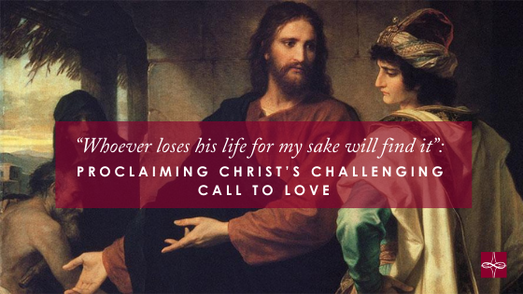
9/7/2021 “Whoever loses his life for my sake will find it”: Proclaiming Christ’s Challenging Call to LoveRead Now
“Then Jesus said to his disciples, ‘Whoever wishes to come after me must deny himself, take up his cross, and follow me. For whoever wishes to save his life will lose it, but whoever loses his life for my sake will find it’” (Mt 16:24-25).
This summer, I’ve been blessed with the opportunity to work as an intern for the Catholic Apostolate Center and collaborate on several catechetical projects with other staff members there. One of these projects was the creation of a new version of From Practicing Catholics to Apostles on Mission, a faith formation course for those who want to delve more deeply into their faith and become more actively involved in the Church. Since many of the program’s participants are young adults, drafting lessons for this course allowed me to reflect on the unique opportunities and challenges that come with speaking to young adults about the Faith. This task always involves a special focus on presenting Church teaching in a way that is clear, approachable, and attractive. But with this task comes a special challenge: how can we avoid the temptation to “water down” the faith or to omit or sugarcoat its more difficult truths? How can we imitate the most perfect preacher, who stated plainly: “Take up your cross and follow me” (Mt 16:24)? One of the Apostles on Mission sessions on which I worked focuses on the universal call to holiness. It seems to me that this teaching is one that we must take care to proclaim in its fullness, especially when speaking to young people: “The Lord Jesus, the divine Teacher and Model of all perfection, preached holiness of life to each and every one of His disciples of every condition…Thus it is evident to everyone, that all the faithful of Christ of whatever rank or status, are called to the fullness of the Christian life and to the perfection of charity” (Lumen Gentium 40). This message shatters the common assumption that holiness is attainable by only a few individuals who perform extraordinary works. It reveals that holiness consists instead in the “perfection of charity” and thus is truly possible for everyone, because although we cannot all accomplish great or miraculous deeds, we can all act with great love. Proclaiming this universal call to holiness is particularly important because—while we hear the commandments over and over—"Love the Lord your God with all your heart…Love your neighbor as yourself”—a very subtle but serious temptation can creep in. Namely, we can be tempted to love only when it is easy, when we find the other person agreeable, when we think they deserve it. But in fact, the perfect love that Christ commands is often difficult. It is difficult to love God daily by resisting temptation, practicing self-denial, and committing ourselves to regular prayer. It is difficult to love our neighbor on a daily basis by treating them with patience, forgiving their faults, and making a generous gift of ourselves to them. Pope St. John Paul II summarized it well in his address to the young people of Boston: “Real love is demanding. I would fail in my mission if I did not clearly tell you so. For it was Jesus—our Jesus himself—who said: ‘You are my friends if you do what I command you’ (Jn 15:14). Love demands effort and a personal commitment to the will of God. It means discipline and sacrifice, but it also means joy and human fulfillment” (Holy Mass on Boston Common, 1979). St. John Paul II not only acknowledges the difficulty of Christ-like love, he also emphasizes that he has a duty to proclaim this difficulty to the Church. He recognized that if we are not warned that “real love is demanding,” we will inevitably discover this reality through our own experience. And if we are not prepared for difficulty, one of two tragic results will likely occur. Finding love demanding, we may be tempted to believe that Jesus didn’t really mean “Be perfect, just as your heavenly Father is perfect” (Mt 5:48) and might ease up and only love when it is easy. Alternatively, we might be tempted to give up in despair, like the rich young man of the Gospel who was taken aback by Jesus’ demanding invitation and “went away sad” (Mk 10:22). Although we must proclaim to young people the difficulty of what Jesus commands, we can also provide them with the hope that enables all Christians to rise to the challenge that lies before them. The first hopeful reminder is this: God is the one who sanctifies us, who always gives us the grace we need to fulfill his call. Cooperating with this grace does require that we are willing to say “yes” to the daily opportunities to undertake the difficult work of loving. But the further hopeful news is that God generously provides hundreds of these opportunities every day. As Pope Francis illustrates in his apostolic exhortation, Gaudete et Exsultate: “This holiness to which the Lord calls you will grow through small gestures. Here is an example: a woman goes shopping, she meets a neighbour and they begin to speak, and the gossip starts. But she says in her heart: ‘No, I will not speak badly of anyone.’ This is a step forward in holiness. Later, at home, one of her children wants to talk to her about his hopes and dreams, and even though she is tired, she sits down and listens with patience and love. That is another sacrifice that brings holiness. Later she experiences some anxiety, but recalling the love of the Virgin Mary, she takes her rosary and prays with faith. Yet another path of holiness. Later still, she goes out onto the street, encounters a poor person and stops to say a kind word to him. One more step.” A third word of hope: Every time we take one of these “steps”—loving even when it is hard—we train our heart, like runners training for a marathon. With each step, our heart grows stronger, and it becomes easier to love the next time. One more message of hope can be found at the end of St. John Paul II’s words that I quoted before: “[Love] means discipline and sacrifice, but it also means joy and human fulfillment” (my emphasis). This message was closely echoed by another great saint of modern times: St. Teresa of Calcutta. She wrote: “We should ask ourselves, ‘Have I really experienced the joy of loving?’ True love is love that causes us pain, that hurts, and yet brings us joy. That is why we must pray and ask for the courage to love.” When we consider the words of both saints, there initially seems to be a contradiction—how can love cause both pain and joy? But this is ultimately the same paradox that lies at the heart of the Gospel: Christ promises that only he who “loses his life for my sake will find it” (Mt 16:25)—that is, only if we “lose” our life in self-giving can we find lasting fulfillment in this life and eternal happiness in the next. It takes courage and great faith to believe in this promise of Christ, but there are two places we can find evidence to support it. The first is in the witness of St. John Paul II and St. Teresa of Calcutta themselves, along with the countless other saints whose lives witnessed to the truth of their words. These men and women loved with total generosity even when it was difficult; they faced many additional sufferings, and yet they were filled with joy—a joy so radiant and constant that it could not have been a mere appearance. We can also find evidence in our own experience that proves the opposite side of this truth: when we have tried to fill our hearts and lives with things that aren’t God, we have all experienced how quickly happiness flees and gives way to emptiness and sorrow. By witnessing the joy of the saints and recalling our own sorrow when we deviate from the path they trod, we can trust that over time, as we continue the demanding work of striving to love as Christ loved, He will gradually reshape our hearts and help us experience the joy that sacrificial loving brings. In summary, when we share the Gospel with young people, we must take care to speak the fullness of the truth and tell them of both the joy and suffering that accompanies the lives of those who follow Christ. By doing so, we help them avoid the fate of those who excuse themselves or fall into despair when they feel the weight of the cross. But even more, doing so helps them find the narrow path that leads to the life they most desire, “life in its fullness,” as St. John Paul II describes: “Jesus does not ask us to give up living, but to accept a newness and fullness of life that only He can give. The human being has a deep-rooted tendency to ‘think only of self,’ to regard one’s own person as the center of interest and to see oneself as the standard against which to gauge everything. One who chooses to follow Christ, on the other hand…looks on life in terms of gift and gratuitousness, not in terms of conquest and possession. Life in its fullness is only lived in self-giving, and that is the fruit of the grace of Christ: an existence that is free and in communion with God and neighbor” (Message for World Youth Day XVI, 2001). It has been a great gift to collaborate with the Catholic Apostolate Center in their efforts to help others recognize and respond to God’s call to holiness, to the fullness of life. May all of us—of every age—heed this call. May we have the courage to proclaim the fullness of the truth, the strength to love when it is difficult, and the confident hope that doing these things will bring the profound peace and joy that we seek.
In 1979, Blessed Teresa of Calcutta, then Mother Teresa, was awarded the Nobel Peace Prize given to “the person who shall have done the most or the best work for fraternity between nations, for the abolition of reduction of standing armies and for the holding and promotion of peace congresses.” Below is a portion of her Nobel Lecture in which she speaks of the joy in her work of enkindling charity and the call we have to pass on this joy to others. And so here I am talking with you - I want you to find the poor here, right in your own home first. And begin love there. Be that good news to your own people. And find out about your next-door-neighbor - do you know who they are? I had the most extraordinary experience with a Hindu family who had eight children. A gentleman came to our house and said: Mother Teresa, there is a family with eight children, they had not eaten for so long- do something. So I took some rice and I went there immediately. And I saw the children- their eyes shining with hunger - I don't know if you have ever seen hunger. But I have seen it very often. And she took the rice, she divided the rice, and she went out. When she came back I asked her - where did you go, what did you do? And she gave me a very simple answer: They are hungry also. What struck me most was that she knew- and who are they, a Muslim family - and she knew. I didn't bring more rice that evening because I wanted them to enjoy the joy of sharing. But there were those children, radiating joy, sharing the joy with their mother because she had the love to give. And you see this is where love begins- at home… …And I know well that you have not given from your abundance, but you have given until it has hurt you. Today the little children they have- I was so surprised - there is so much joy for the children that are hungry. That the children like themselves will need love and care and tenderness, like they get so much from their parents. So let us thank God that we have had this opportunity to come to know each other, and this knowledge of each other has brought us very close. And we will be able to help not only the children of India and Africa, but will be able to help the children of the whole world, because as you know our Sisters are all over the world. And with this prize that I have received as a prize of peace, I am going to try to make the home for many people that have no home. Because I believe that love begins at home, and if we can create a home for the poor- I think that more and more love will spread. And we will be able through this understanding love to bring peace, be good news to the poor. The poor in our own family first, in our country and in the world. To be able to do this, our Sisters, our lives have to be woven with prayer. They have to be woven with Christ to be able to understand, to be able to share. Because today there is so much suffering - and I feel that the passion of Christ is being relived all over again - are we there to share that passion, to share that suffering of people. Around the world, not only in the poor countries, but I found the poverty of the West so much more difficult to remove. When I pick up a person from the street, hungry, I give him a plate of rice, a piece of bread, I have satisfied. I have removed that hunger. But a person that is shut out, that feels unwanted, unloved, terrified, the person that has been thrown out from society - that poverty is so hurtable and so much, and I find that very difficult. Our Sisters are working amongst that kind of people in the West. So you must pray for us that we may be able to be that good news, but we cannot do that without you, you have to do that here in your country. You must come to know the poor, maybe our people here have material things, everything, but I think that if we all look into our own homes, how difficult we find it sometimes to smile at each other, and that the smile is the beginning of love.
And so let us always meet each other with a smile, for the smile is the beginning of love, and once we begin to love each other naturally we want to do something. So you pray for our Sisters and for me and for our Brothers, and for our Co-Workers that are around the world. That we may remain faithful to the gift of God, to love Him and serve Him in the poor together with you. What we have done we should not have been able to do if you did not share with your prayers, with your gifts, this continual giving. But I don't want you to give me from your abundance, I want that you give me until it hurts. The other day I received 15 dollars from a man who has been on his back for twenty years, and the only part that he can move is his right hand. And the only companion that he enjoys is smoking. And he said to me: I do not smoke for one week, and I send you this money. It must have been a terrible sacrifice for him, but see how beautiful, how he shared, and with that money I bought bread and I gave to those who are hungry with a joy on both sides, he was giving and the poor were receiving. This is something that you and I- it is a gift of God to us to be able to share our love with others. And let it be as it was for Jesus. Let us love one another as he loved us. Let us love Him with undivided love. And the joy of loving Him and each other- let us give now - that Christmas is coming so close. Let us keep that joy of loving Jesus in our hearts. And share that joy with all that we come in touch with. And that radiating joy is real, for we have no reason not to be happy because we have no Christ with us. Christ in our hearts, Christ in the poor that we meet, Christ in the smile that we give and the smile that we receive. Let us make that one point: That no child will be unwanted, and also that we meet each other always with a smile, especially when it is difficult to smile. |
Details
Archives
November 2025
Categories
All
|


RSS Feed