It’s hard to believe that the 350th anniversary of the apparitions of the Sacred Heart of Jesus to St. Margaret Mary concluded this past week. Communities within the Church were keen to observe this occasion, such as the Knights of Columbus through their Pilgrim Icon Program. Devotion to the Sacred Heart is special in my own spiritual life, a devotion that I share with my best friend. I started this particular devotion when I was in seminary, studying to be a priest at a previous point in my life. The Sacred Heart is Jesus' invitation to return to the heart, to the center of who we are as a person. The heart is the core of our being, where we can encounter the divine love of Jesus. It is at the heart where Jesus was moved to compassion whenever he encountered those suffering and afflicted, as we hear in the gospels. In his last encyclical, Dilexis Nos (He Loved Us), Pope Francis reminded us that the heart is the pulse of humanity and we need to return to the heart in order to remember who we are: God’s beloved. “The heart of Christ is ‘ecstasy’, openness, gift and encounter. In that heart, we learn to relate to one another in wholesome and happy ways and to build up in this world God’s kingdom of love and justice. Our hearts, united with the heart of Christ, are capable of working this social miracle,” (no. 28). The Sacred Heart has a unifying effect when embraced. During the Jubilee of the 350th anniversary, my family welcomed the Sacred Heart of Jesus through a Sacred Heart Enthronement. I came across this beautiful tradition through the Sacred Heart Enthronement Network, a nonprofit based out of Columbus, OH that was established to help others live out and promote Devotion to the Sacred Heart of Jesus. Through their outreach apostolate, Welcome His Heart, individuals have the opportunity to fulfill that devotion through the home enthronement process. A home enthronement can be carried out in five easy steps:
My family chose to do a Sacred Heart Enthronement this past Sunday, June 22nd, on the Solemnity of the Most Holy Body and Blood of Christ. This was a great occasion to commemorate the conclusion of the National Eucharistic Revival and the Jubilee of the 350th anniversary. There is a beautiful relationship between the Eucharist and the Sacred Heart, particularly through the First Friday Devotion where the faithful are invited to seek the Sacrament of Reconciliation, attend Mass, and receive Holy Communion on the first Friday of each month to make reparation to the Sacred Heart. As Pilgrims of Hope during this Jubilee Year of Hope, I invite you to consider welcoming the Sacred Heart of Jesus into your home. Make this beautiful tradition a part of your own family tradition. When Jesus appeared to St. Margaret Mary, he spoke of 12 promises to those who honor his sacred heart. Two of those promises include Jesus giving us the necessary graces for their state in life and giving us peace in our families. At a time when peace is desperately needed in our world, let us start with our families and welcome the Sacred Heart of Jesus into our home!
0 Comments
June is the month of the Sacred Heart of Jesus, and June 27th— the day after this blog post’s publication — is the Solemnity of the Sacred Heart of Jesus. It was the Lord Himself who revealed the devotion of the Sacred Heart to St. Margaret Mary Alacoque in a series of visions between 1673-1675. There is much that can be said about the Sacred Heart, such as the details of its design, the twelve promises, and its rich theological background, which even precedes the visions given to St. Margaret Mary. The Sacred Heart, like all matters of our faith, is not meant to exist as an ethereal theological concept but must be appropriated as a way to encounter the infinite love of God. This heart, we hope, will replace ours so that we can love like God. We should consider some of the ways that God loves, which are the ways we aspire to love. The heart of Jesus is a heart that… 1. Sees the beloved for who they are I must admit, I’ve stolen this from my friend Katie Prejean-McGrady (or I should say that I have taken inspiration from!). At a recent conference, Katie gave a keynote in which she focused on the story of the Rich Young Man from the Gospel of Mark. She keyed in on the words, “Jesus, looking at him, loved him,” and those words have stuck with me in the weeks since. How many people are looking for meaning, for purpose, and to be recognized as good? As a college campus minister, I encounter many young people who are asking these same questions, who are seeking, as John Green often quotes, “to know and be known, to love and be loved.” The Sacred Heart, the same heart which beats within our Lord in this moment in Mark, is one that sees us and loves us. If we are to love like Christ, to do so with His heart, we must look with compassion at every person we encounter, listen to them, journey with them through their questions, and gaze upon them with the gaze of Christ which we have encountered in our own lives. 2. Doesn’t condemn The Sacred Heart is one not of judgment, but of great love. Jesus is very clear in his ministry in the gospels, condemnation is not his goal, but love. In John 3:17 we read, “For God did not send his Son into the world to condemn the world, but that the world might be saved through him.” We are sinful people, and pride is often at the root of that sinfulness. We encounter people every day with whom we disagree, who are living in a way that perplexes us, and people who distress or frustrate us. But to love with a heart like God’s is not to condemn them, but to will their good. We are called to encounter those we meet, friend and “enemy” alike, with compassion, putting aside our preconceived notions and biases, and offering them a compassionate gaze that can, over time, open both of us to an encounter with the Sacred Heart of Jesus. Just a few chapters after John 3, Jesus encounters the woman caught in adultery where the call to withhold condemnation meets its partner. 3. Calls the beloved higher In John 8, as Jesus encounters the woman caught in adultery and the crowd which wishes to stone her, Jesus disbands the crowd by saying, “Let the one among you who is without sin be the first to throw a stone at her.” The crowd disperses and He says to the woman, “Has no one condemned you?” the woman replied, “No one, sir.” Jesus then responds, “Neither do I condemn you.” But he does not end there. Jesus finishes his statement with, “Go, [and] from now on do not sin any more.” To love with the heart of God means seeing with eyes of compassion, it means not condemning the ones we love, but it also means calling our beloved higher! Jesus, whose love is perfect charity, is not permissive of anything that our broken hearts want, but is a love that always calls us higher. If we love like God, we should call those we love higher, not to meet us eye to eye, but to live a life of communion with God who is love and being itself! We cannot call people higher, though, if they do not trust that we love them, which requires us to accompany them patiently, seeing them with the compassion of Christ. As we close out the month of June, the month of the Sacred Heart, let us ask the Lord to cleanse our hearts and enlarge them so that we might be better vessels of his love. Let us live this love by looking at those we love for who they are with eyes of compassion, by not condemning, and by calling those we love higher. Sacred Heart of Jesus, have mercy on us!
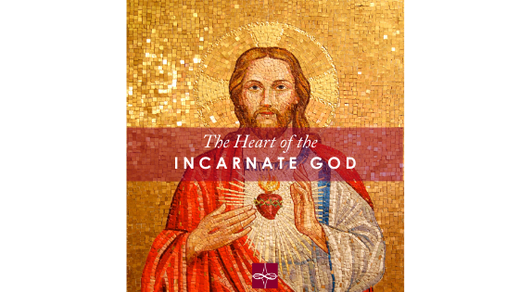
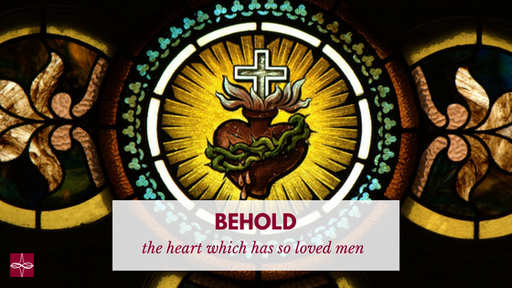
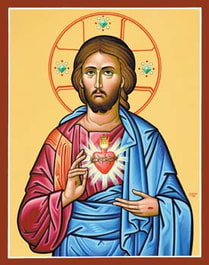
There are few religious images that hold more significance for me than that of the Sacred Heart of Jesus. My grandmother, a pillar of faith in our Mexican-American family, kept a framed copy of the image in her bedroom, adorned with numerous prayer cards, mementos, and old palm branches. For a young child walking by the door, that image seemed both mysterious and comforting. What was it actually depicting and why should it be a focus of such devotion? Who was this Jesus who stared out at me, gesturing to the flaming heart in his chest, poised as if to offer it out through the frame of the picture? Only years later would the full meaning of the image become apparent, as I learned more about the history of Christianity and the fundamental meaning of the Incarnation. Devotion to the Sacred Heart of Jesus, which developed particularly in 17th century France from earlier medieval devotions to Christ, is about much more than the image itself. Given particular shape by the writings and experiences of figures such as St. John Eudes and St. Margaret Mary Alacoque, the devotion is a way of contemplating more deeply the mystery of God’s love for humanity expressed in the true human existence of the Son of God as the Incarnate Word. Ultimately, the image and devotion remind us that the God we confess as Christians is not a powerful yet distant God. Rather, the God who so loved the world (Jn 3:16) loved us in such a way that he truly entered into human life, becoming a human being not merely in appearance but complete with body and soul, mind and heart. In a certain way, the devotion trains our minds to resist passing over the Incarnation as simply a well-worn article of doctrine, affirmed as a matter of course but rarely considered more closely for its radical implications. Christianity is not ultimately a belief in formulas but rather an encounter with God in faith expressed, preserved, and remembered authentically through such fundamental doctrines as the Incarnation (cf. Catechism of the Catholic Church §170). As Pope Benedict XVI wrote so beautifully in his first encyclical, Deus Caritas Est, “being Christian is not the result of an ethical choice or a lofty idea, but the encounter with an event, a person, which gives life a new horizon and a decisive direction” (Deus Caritas Est, §1). The devotion to the Sacred Heart, and the strikingly concrete image of a human heart, presents this encounter in high relief. Jesus Christ is much more than a moral teacher or religious sage. He is much more than a simple mode of communication between God and human beings, or a courier of divine knowledge and commandments. He is, instead, the Good Shepherd who has come to us, whose heart is moved with pity. He is the Bridegroom who has loved us with a human heart and given himself completely for us. He is the God who is Love (1 Jn 4:8), who unites to himself a human heart in the Incarnation and transfigures it with the fire of divine love as the heart of the Incarnate God. This good (and truly astounding) news is depicted in the gaze and kindled heart, the crown of thorns and the cross, of the image of Jesus that hung in my grandmother’s bedroom. The image and devotion, so widespread now as to feel fundamentally traditional, invites all Christians to return in awe to an encounter with this God who has loved us and humbled himself so much for our sake, “becoming obedient to death, even death on a cross” (Phil 2:8). On this Solemnity of the Most Sacred Heart of Jesus, may we turn to Jesus, who is turned to us and always has his eyes fixed lovingly upon us (cf. St. John Eudes, Letter 9), so that we may “know the love of Christ which surpasses knowledge… [and] be filled with all the fullness of God” (Eph 3:19). Whenever you think of Christianity, it is next to impossible to overlook the role and importance of love in the story of salvation. God’s love for us is one that is infinitely more enduring than any infatuation or passing attraction. It is one that gives and purifies, sacrifices and yields for the good of another -- again and again and again. God’s love is one that extends through, before, and beyond eternity and is ultimately expressed from Calvary to each and every person, fully, freely, and forever. The Church has dedicated the month of June to a reminder of the depth of God’s love: the devotion to the Sacred Heart of Jesus. In His Most Sacred Heart, we see how absolutely consumed with love God is for us — so much so that He was willing to bear those heinous wounds, false accusations and derisions, and even His death in order to grant salvation for all. Artistic depictions of the Sacred Heart remind us of the torment Christ endured on our behalf: the heart is wrapped in a crown of thorns, pierced, bleeding, and aflame with a cross rising from the tongues of fire. The visible wounds of Christ’s heart reveal His invisible love. Thus, devotion to the Sacred Heart is described as “devotion to the love of Jesus Christ in so far as this love is recalled and symbolically represented to us by His Heart of Flesh.” As creatures that have both soul and body, bodily representations of Christ’s love sometimes touch us in ways that words do not. The Sacred Heart teaches us that authentic love incurs great costs, but it also always gives life. Historically, devotion to the Sacred Heart is believed to have grown from another devotion to Jesus’ body: the Sacred Wounds of Christ from His Passion. Saint Bernard of Clairvaux said that the piercing of Christ’s side revealed His goodness and the charity of His heart for us: “How good and pleasant it is to dwell in the Heart of Jesus! Who is there who does not love a Heart so wounded? Who can refuse a return of love to a Heart so loving?” Other religious and saints, such as Francis of Assisi, have themselves exemplified closeness to the love poured out by Christ’s Five Wounds and Sacred Heart. The devotion as it is most commonly known today is said to have begun with the 1673 appearance of our Lord to St. Margaret Mary Alacoque, a French nun of the Order of the Visitation of Holy Mary. Over a series of visits, Our Lord revealed to St. Margaret Mary the importance of devotion to His Sacred Heart: "Behold the Heart which has so loved men that it has spared nothing, even to exhausting and consuming Itself, in order to testify Its love … But what I feel most keenly is that it is hearts which are consecrated to Me, that treat Me thus. Therefore, I ask of you that the Friday after the Octave of Corpus Christi be set apart for a special Feast to honor My Heart, by communicating on that day, and making reparation to It by a solemn act, in order to make amends for the indignities which It has received during the time It has been exposed on the altars. I promise you that My Heart shall expand Itself to shed in abundance the influence of Its Divine Love upon those who shall thus honor It, and cause It to be honored." In 1856, the Solemnity of the Sacred Heart was officially added to the liturgical calendar — the day before the Memorial of the Immaculate Heart of the Blessed Virgin Mary. The faithful have several options for honoring the Sacred Heart as requested by our Lord:
The Love that Christ continually showers on us should totally consume us. Christ’s death is an infinitely huge debt that we can never repay—but in His infinitely huge capacity to love and be merciful, all our Lord asks in return is our love. As we are invited to share in His Divine Love, we are called to let that love change us to become better disciples and better witnesses. Most of all, let us strive to become authors of great love stories, never ceasing to wonder at the incredible truth that the God of the Universe loves us! The Solemnity of the Most Sacred Heart is also the World Day of Prayer for the Sanctification of Priests. Please pray for the priests in your parish and any other priests who have touched your life! |
Details
Archives
January 2026
Categories
All
|


RSS Feed